Researchers: Annas Bin Adil, Soumik Mukherjee, Stephanie Owyang, Ryan Reuther, Gia Schutzer
Pulse Check.
Capstone for Arrhythmia Detection
Welcome to Pulse Check. We are focused on advancing real-time arrhythmia detection using consumer-grade ECG data. Our work explored how consumer wearables, paired with on-device machine learning, can help surface earlier identification of cardiac irregularities. The site outlines our mission, product, research approach, modeling techniques, and key findings, offering a view into the potential of accessible, proactive heart-health monitoring.

Our Mission
Accessible, proactive heart health for all
To empower individuals with an accessible and affordable solution into managing their heart health, enabling earlier detection of dangerous arrhythmias and reducing preventable cardiac events.
Our Product
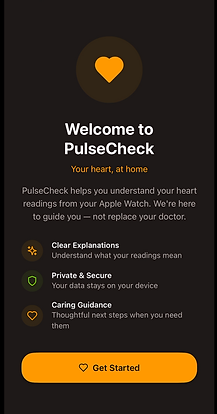
Pulse Check is a React Native mobile application that ingests ECG data directly from the Apple Watch via HealthKit. The app preprocesses each ECG recording, runs it through our on-device arrhythmia detection model, and provides the user with a clear, real-time signal on whether an irregular rhythm may be present. The experience is designed to be simple, fast, and accessible.


Technology

1
Training Model
We trained a custom arrhythmia-detection model using a 12 lead ECG dataset aligned to Apple Watch signal characteristics. The pipeline includes filtering, resampling, segmentation, and knowledge distillation training to classify irregular rhythms.
2
React Native App
The mobile app serves as the user interface layer. It integrates with Apple HealthKit to retrieve ECGs and provide insights into heart health. We built it for speed, simplicity, and cross-platform deployment to Apple and eventually Android devices.
3
On-Device Inference
All predictions run locally on the user’s device using a lightweight model exported for mobile. This enables faster results and improved privacy.
Model Architecture

Research Findings
Different ECG hardware systems use various heartbeat sensing technologies, resulting in signals with different frequencies, amplitude scaling, and noise characteristics.
The lack of details into device-specific signal preprocessing visibility makes model generalization a non-trivial matter as different signals will limit the model’s ability to perform inference on the apple watches ECG data.
To align these signals, we designed a cleaning process aligning with common ECG standards and analyzed signals using Power Spectral Density plots.
Aligning signals from sources such as clinical ECG machines and consumer devices like the Apple Watch ensures that predictive models for arrhythmia detection or heart health monitoring can generalize reliably.
Key Findings
Cross-device compatibility
Models trained on one type of ECG data can accurately interpret data from other devices, reducing the need for separate pipelines or retraining.
Improved diagnostic consistency
Cleaning and standardizing signals minimizes noise and artifacts, leading to more reliable feature extraction and downstream predictions
Scalable deployment
The preprocessing steps allow for a more seamless integration of new ECG sources, supporting large-scale health monitoring applications
Our Team.